

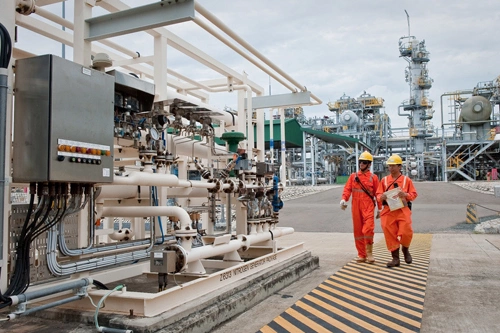
The master plan aims to achieve objectives for the gas industry through 2025, with a vision extending to 2035.
The master plan for the development of Vietnam's gas industry was recently announced by the Vietnam Oil and Gas Group (PVN) at a conference in Hanoi.
Accordingly, the plan seeks to realize the gas industry objectives outlined in the Strategy for the Development of Vietnam's Oil and Gas Sector—approved by the Prime Minister—covering the period up to 2025 with a vision toward 2035.
In this context, the Government has set forth key guiding principles, such as aligning the development of the gas industry with the national power development strategy and planning. This approach aims to utilize clean fuel sources efficiently, thereby contributing to national energy security and the reduction of greenhouse gas emissions. The sector will leverage domestic resources and enhance international cooperation while ensuring the economical, efficient, and rational use of domestic resources. Furthermore, the plan involves implementing liquefied natural gas (LNG) imports and gathering new domestic gas sources to supplement declining supplies, ensuring a continued gas supply for consumers.
The master plan also addresses the completion of infrastructure for gas collection, transportation, and processing—prioritizing the maximization of existing infrastructure capacity—while simultaneously developing and finalizing facilities for LNG storage, importation, and distribution.
Furthermore, the gas industry needs to accelerate investment in deep processing and product diversification to enhance the utility and economic value of natural gas and its derivatives.
According to Mr. Dang Huy Cuong, Director General of the General Department of Energy (Ministry of Industry and Trade), PVN is actively deliberating on the industry's development; the group has conducted thorough assessments of practical implementation challenges and put forward numerous valid recommendations.
This aligns with the Government's strategic direction, which emphasizes establishing a policy framework to gradually transform the management and business models of Vietnam's gas industry toward a free-market system integrated with regional and global markets.
The General Department of Energy stated that developing the gas consumption market based on a market-oriented mechanism—with State regulation—and encouraging foreign contractors and investors to participate across the entire gas value chain (upstream, midstream, and downstream) will contribute to ensuring the nation's long-term energy security.
As an entity directly engaged in gas production and business operations in Vietnam, a representative from PetroVietnam Gas (PV Gas) outlined several immediate measures to develop the gas industry. These include forecasting gas market supply and demand, upgrading gas supply infrastructure, establishing mechanisms and policies for gas pricing and investment management—specifically adopting a project-chain management model—and decentralizing investment and bidding management to accelerate project implementation.
PVN leadership advocated for increased investment in deep gas processing. Gas processing generates significant value-added benefits and yields products that support the national economy while aligning with the scale of Vietnam's gas fields.
In addition to proposals for market forecasting and investment risk assessment, PVN emphasized that relevant entities must focus on three critical areas: securing gas supplies, ensuring robust infrastructure, and conducting in-depth market research (covering customer bases and gas pricing).
Source: vnexpress.net